
The Hidden Gardens of Paris
Updated June 2026
Two centuries ago, Emperor Napoleon III transformed Paris into a modern metropolis — and in doing so, became one of history's great champions of public green space. He gifted two vast former hunting grounds — the Bois de Boulogne to the west and the Bois de Vincennes to the east — to expand the city's boundaries, and linked them to the historic Tuileries and Luxembourg gardens to create a network of parks for Parisians and visitors alike.
Less well known is what he did next. Napoleon III quietly tucked small squares and gardens into each of the twenty arrondissements, ensuring that every Parisian has a favorite local retreat close to home. Nestled into corners and off the beaten path, these lesser-known gardens are not necessarily secret — but they are beautifully hidden. Each one offers an unexpected pleasure: a place to watch birds, discover heritage roses, or simply sit and read while waiting for a train.
Here is our guide to some of our favorite spots.
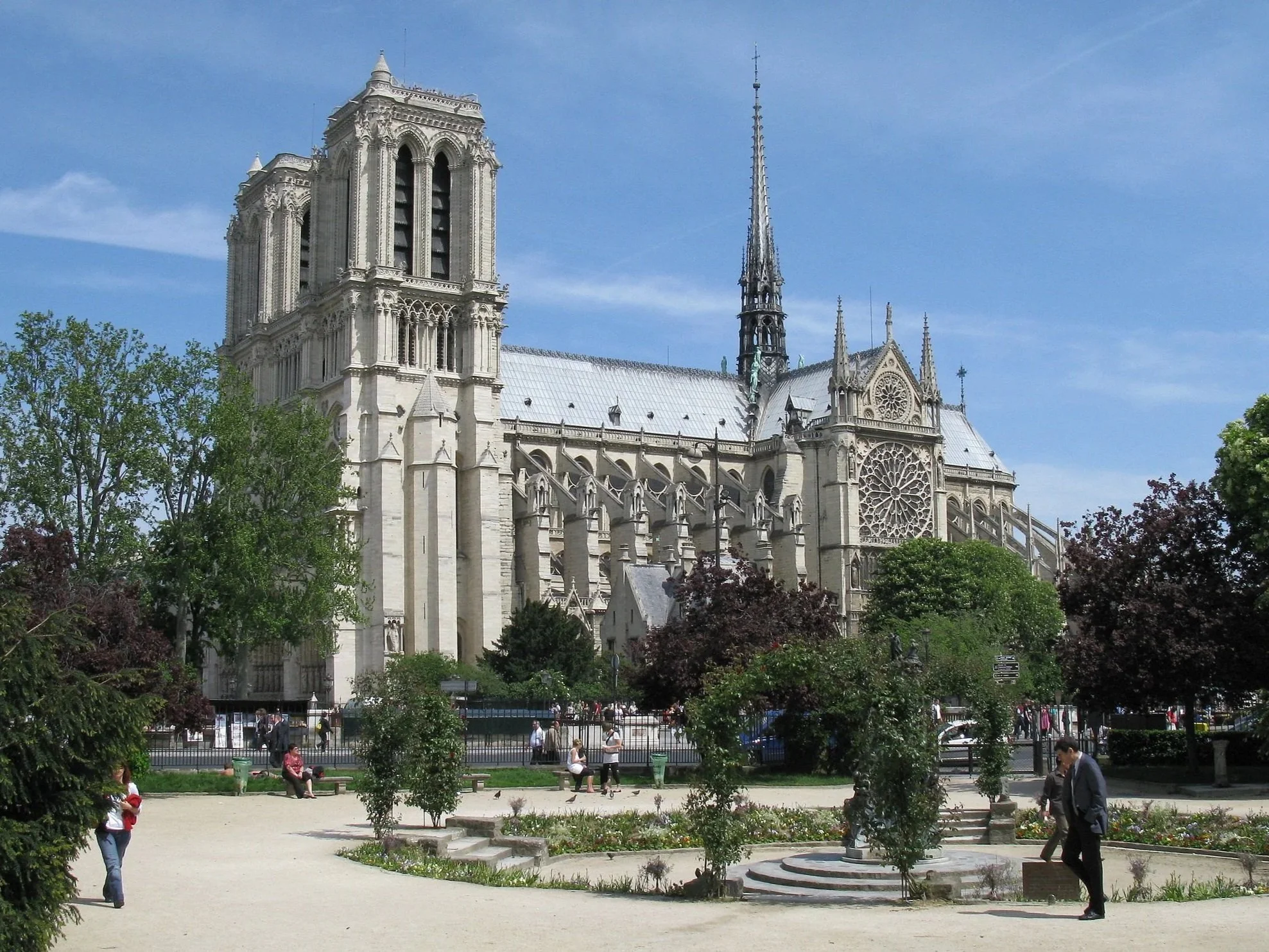
Square Rene Viviani, Spencer Means / Flickr
The Square René-Viviani
Located on the Left Bank, directly across from Notre-Dame, the Square René-Viviani is a tranquil refuge with a remarkable distinction: it is home to what is believed to be the oldest tree in Paris — a false acacia, brought to France from Virginia in 1601, that still stands in this very spot. From the park benches, you can take in one of the finest views in the city: Notre-Dame to the right, and the ancient church of Saint-Julien-le-Pauvre — built in the same era — to the left. As Notre-Dame continues its journey of restoration and renewal, this quiet corner offers a rare moment of contemplative beauty.

Jardin Atlantique, SiefkinDR / CC
Jardin de l’Atlantique
Ever wonder what to do with an hour at Gare Montparnasse? Follow the signs and climb the stairs to discover the Atlantic Garden — planted directly above the railway station itself. A feat of engineering opened in 1994, the garden was conceived as a green "ship" floating between office towers, with lampposts serving as masts and raised walkways evoking the bridge of a vessel. Its trees and shrubs evoke the landscapes of Atlantic France — the very regions the trains below are bound for.
At its center, surrounded by lawn, is the Isle of the Hesperides — named for the legendary islands the Ancient Greeks believed lay to the west of the known world. Here, sculptor Jean-Max Llorca's fountain incorporates monumental meteorological instruments measuring rain, temperature, wind, and atmospheric pressure. A series of small thematic gardens lines the eastern edge, each planted with a different palette: swaying grasses, aquatic plants, flowers in blue and mauve, and coastal pines.
Address: Place Raoul Dautry, 75015 Paris

Maison de l’Amérique latine, Dalbera / Flickr
Maison d’Amerique Latin
On the Boulevard Saint-Germain, the Maison de l'Amérique Latine occupies two former 18th-century hôtels particuliers — the Hôtel de Varengeville and the Hôtel Amelot de Gournay — each with a beautifully preserved French formal garden. Dedicated to Latin American culture and home to a rotating program of contemporary exhibitions, the estate is as rewarding to visit for its art as for its grounds. Beyond the gallery doors, a shady terrace opens onto an expansive lawn: one of the most elegant hidden outdoor spaces on the Left Bank.
Address: 217, boulevard Saint-Germain, 75007 Paris
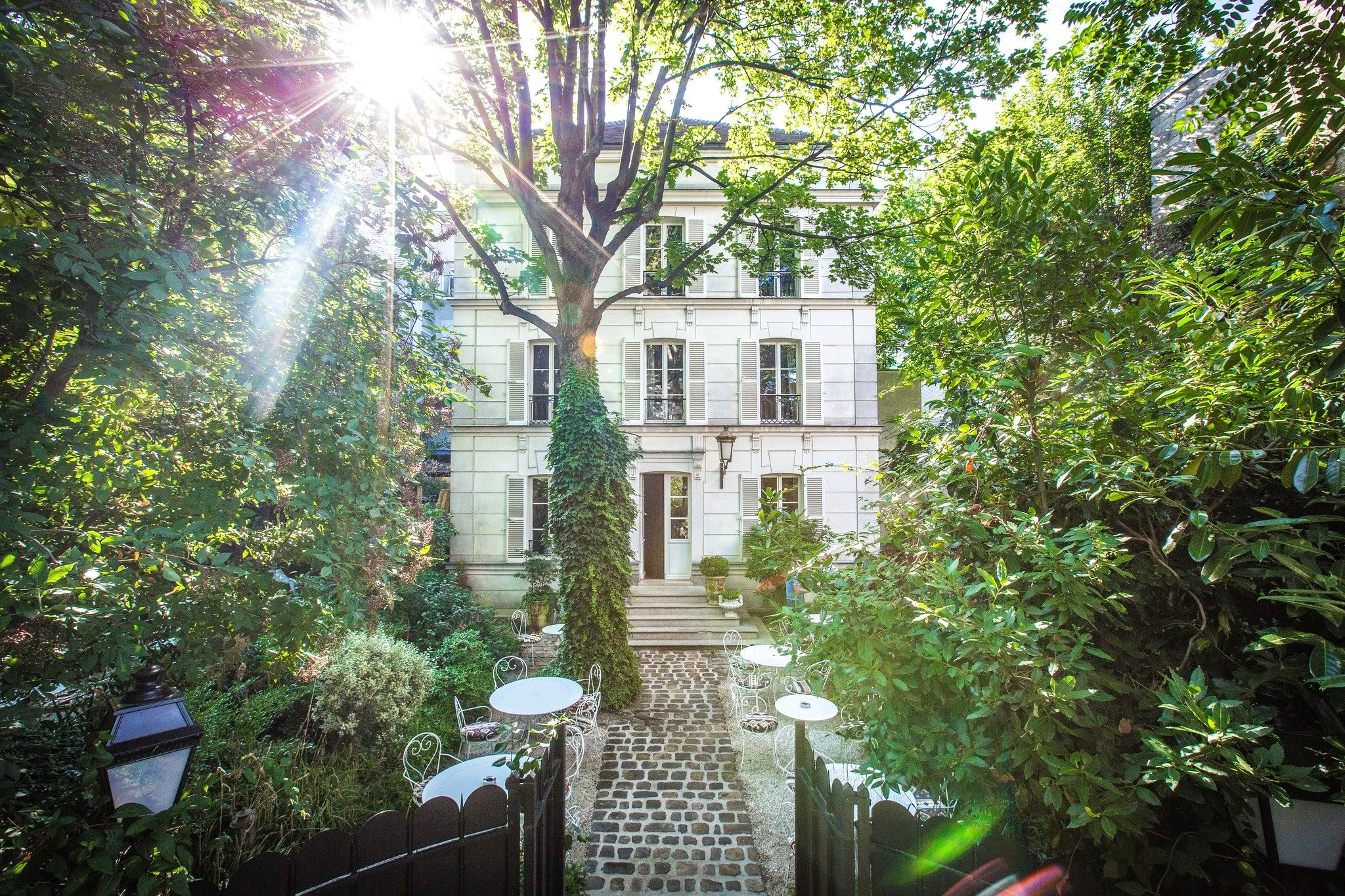
Hôtel Particulier Montmartre / Facebook
Hôtel Particulier Montmartre
To find one of Paris's most beautiful hidden retreats, you must earn it: climb to the top of the Butte Montmartre, then slip behind avenue Junot. Tucked away from the tourist crowds is a large private garden complete with a pétanque area and a kitchen garden — the very picture of Parisian village life. Within this bucolic setting, the Hôtel Particulier Montmartre, a former country house converted into a boutique hotel, remains a destination in its own right. On warm evenings, the garden fills with the kind of unhurried, convivial atmosphere that Paris does better than anywhere.
Address: 23, avenue Junot, Pavillon D, 75018 Paris

Square des Batignolles
Square Batignolles & Park Martin Luther King
In the 17th arrondissement, the Square des Batignolles transports you gently back to the 19th century. Its undulating English-style lawns are shaded by trees planted in the 1830s; a single palm tree, sheltered in a glass gazebo, adds a quietly surreal note. Ducks and geese claim the wandering stream; children take over the playgrounds. A few minutes away, the Parc Martin Luther King strikes an entirely different register. Redesigned by landscape architect Jacqueline Osty on former railway land, the park is a showcase for sustainable design: low-maintenance plantings, solar panels, wind turbines, reclaimed materials, and a rainwater harvesting system that would have impressed Haussmann himself.
Address: Square des Batignolles, 75017 Paris
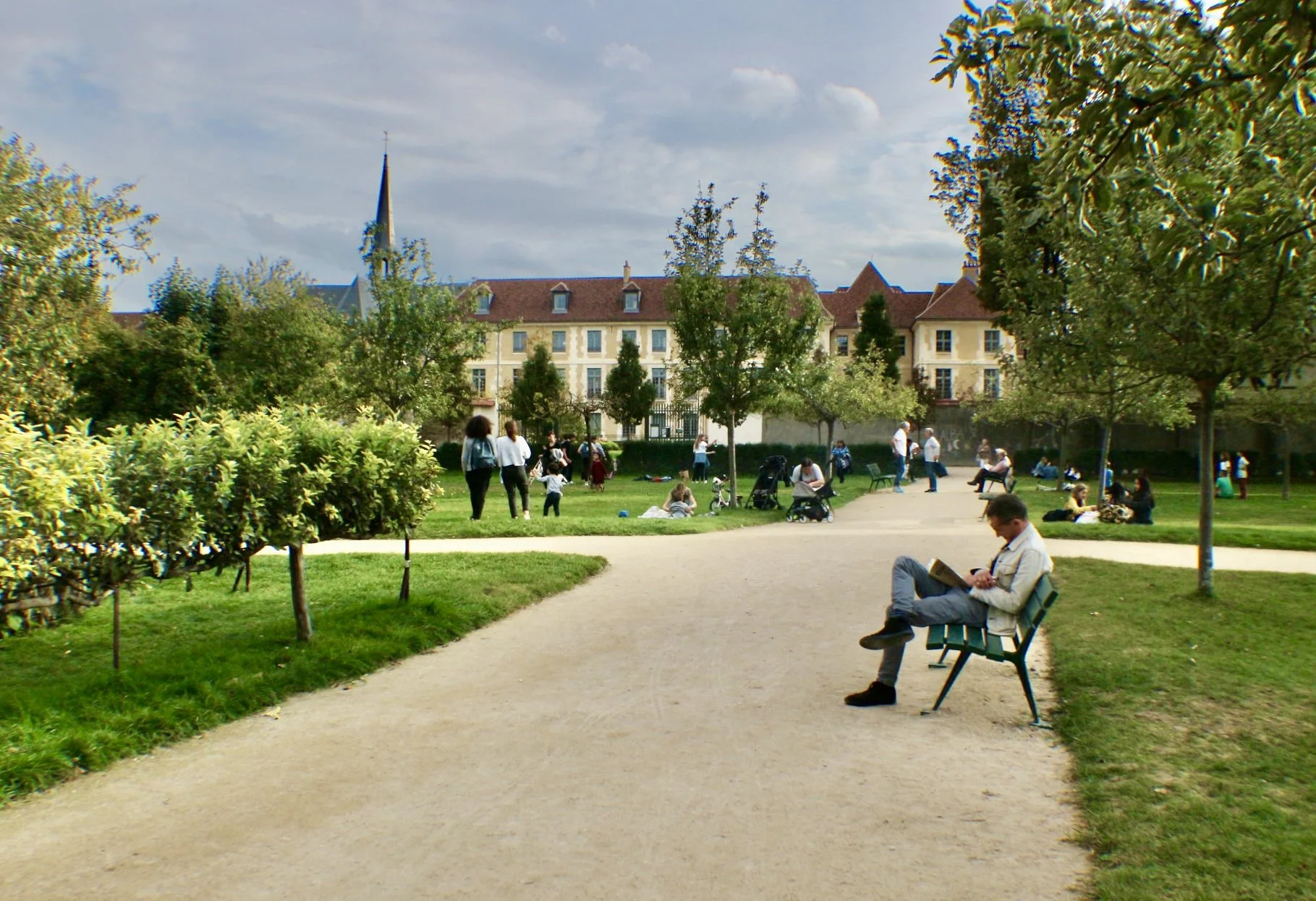


Jardin Catherine Labouré
Jardin Catherine Labouré
This garden takes its name from a 19th-century nun to whom the Virgin Mary is said to have appeared as she tended the convent's kitchen garden nearby. Today's visitors come for rather more earthly pleasures: 7,000 square meters of lawns, fruit trees, a vine-covered pergola, and a working vegetable garden that has survived the passage of time with remarkable grace. The cross-shaped paths trace the outline of the original convent buildings — a quiet reminder, for those who notice it, of the garden's contemplative origins. In summer, it is a favorite spot for sunbathing, picnicking, and the kind of peaceful afternoon that Paris makes feel effortless.
Address: 29 rue de Babylone – Impasse Oudinot, 75007 Paris
Discover Paris's Hidden Gardens with Picturesque Voyages
These gardens are best experienced with someone who knows their stories. Susan Taylor-Leduc — award-winning author, garden historian, and founder of Picturesque Voyages — has spent years uncovering the layers of history, art, and culture woven into the green spaces of Paris and Versailles. Whether you are planning a private tour or a curated experience for your clients, we would love to show you the Paris that most visitors never find.